NH Portraits — A Conversation with GUSKY
GUSKY is an American multidisciplinary artist and writer who's work moves between painting, writing, and intuitive image-making. In this portrait he discusses the origins of his practice, the themes that hold him, and the pieces he brought into Ninth Heaven.
How would you describe your primary craft or discipline? How do you work? Do you have routines, habits, or conditions that support your practice?
My work emerges from my life. I've been fortunate to have worked through several day-job careers that provided sustained contact with all kinds of people: doctors, marketeers, journalists, teachers, kids, artists, actors, programmers, writers, musicians, poor and rich folks, people from around the world. They've all found a place in my psyche, and, for whatever it's worth, can't seem to find a way out. Consequently there are many voices and visions bouncing around in here (points to head). They power my visual art and writing, and, generally, refuse to shut up.
Consequently it only makes sense that my work is multidisciplinary. Up until the end of the last century it was generally expected that serious artists would zero in on a single kind of work, then stamp it out endlessly until they dropped dead. This paradigm was never organic or true to the human creative spirit. It's been gratifying over the past few years to see both artists and institutions awakening to the reality that each artist is an entire, distinct art world, one often filled with differing, divergent movements and interests.
As regards work habits, I live in my workspace. Paintings and writings lay out in the open. There's no escaping them. I work any and all times of the day and night as interest and energy dictate. I often reach a stage in which I hide a work, don't touch it for a week or longer, then return to it with fresh eyes. I work until the piece possesses a psyche all its own, stands up to interrogation, and demands nothing more from me.
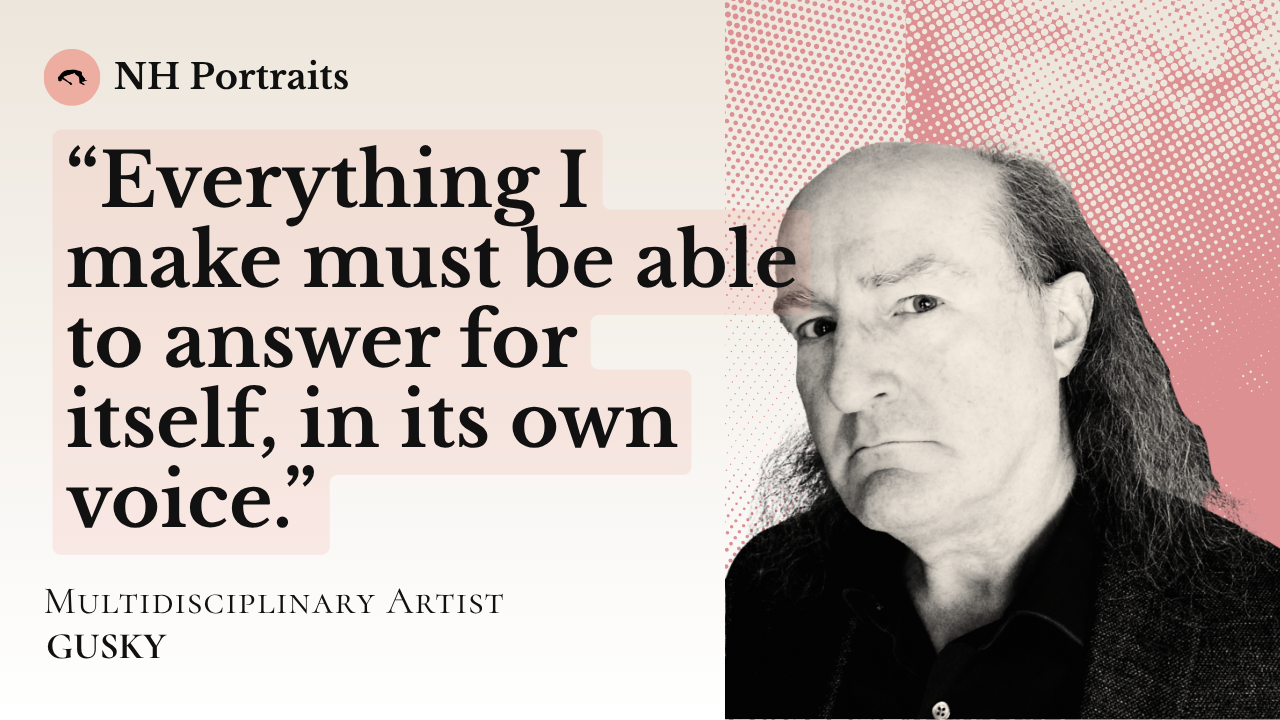
I'm not a factory and don't generate inventory. The art-school maxim that artists must constantly be making art has gifted the world with landfills of bad art. My organic, intuitive approach to art-making and writing puts great demands on me for each individual piece. Everything I make must be able to answer for itself, in its own voice. Everything must give.
How would you introduce the work you published with Ninth Heaven, and why did you choose to make this piece?
My artworks seen in Ninth Heaven are great examples of my multidisciplinary approach to visual art.
“Apex” is a juxtaposition of creatures I saw in real life, walking along a Florida beach. I was struck by the way in which the apex scavenger ruled over the apex predator who’d somehow found himself out of his element. The stained watercolouring is an approach I've used time and again for years now. It makes me feel a sense of time, as though the image is somehow historical, perhaps a hundred or more years old.
“Recovery” is a straight realist take on a home experience, when my wife got Covid while I was cleaning out the closets. I'd checked in on her; she was sleeping in the middle of the day, which pretty much never happens. And I saw this metaphor for life. It grew on me for a few weeks, until finally I had to let it out.
“Swing” is a more fanciful image, also from life. I'd snapped a shot of my niece swinging at night beneath streetlight. The yawning emptiness beneath her made me think of the way, when you're a child, that life can sometimes feel like it's swallowing you up. You have control over so little. You fall into everything again and again.
“Broken Argument” is a kind of artwork that arises from time to time in my life, in which two organisms dialog. Human relationships have always been a mystery to me. You can never know what need you're answering to when someone chooses you for company, even when it's someone you think you know quite well. I've had conversations that seemed unremarkable at the time, then later on heard that the other party's experience was greatly different from my own. Either I'd angered them, or I'd spoken quite directly to a need they never brought up, helping them in ways I'd never have been able to, intentionally. It turns out that, when simply engaged in small talk, I speak the way I make art and write: intuitively. Working from the exact moment and situation. What arises isn't from my intent, but from the subconscious miasma.
As with “Broken Argument”, “Co-Op City of God” is an intuitively created artwork, a dialogue between me and materials that answers to needs I'd be hard-pressed to define. This work came from a 9×12-inch sketchbook that's thick with many kinds of artworks. I like in particular how it looks as though it could have been pulled from a psalter, the way the image invokes mystical visions.
“Tragic Portrait” is yet another intuitively created work. It sits at a juncture of Cubism, Pop, and cartooning that I find particularly entertaining. Artworks like this remind me that, at the heart of our efforts, we who brave the multidisciplinary waters are in fact synthesisers, and our powers come from the past as well as the present.
What themes or questions do you return to most often? Why do they hold you?
I'm drawn to the Predicament, this situation in which we're all consciousnesses trapped in physical bodies which, themselves, are trapped in societies and ecologies that are deeply damaged. We'd be much happier floating around the universe free of hangnails, mobile contracts, and those plastic packages you need a chainsaw to open. We're tangled in a tapestry of history and society and our own physical and emotional needs, doomed never to escape. But these minds of ours grind on anyway, as though it's all just a bad dream, spinning yarns and visions. If we're very, very lucky, we discover little windows of freedom that last for breathless seconds, or even minutes.
Sometimes these little windows are paintings, or drawings, or short stories, or longer stories, or screenplays. If they're mine, they arise from any of the many dimensions of the Predicament.
Most recently, I've been dealing with the part of the Predicament where the body ages, the loved ones die off, faith evaporates, and you find yourself standing at the edge of a strange desert that you suddenly realise is the life you've always lived.
What principles or convictions guide the way you write, think, or create, and where do they come from?
Somehow, during my complicated upbringing, I missed the part about learning how to shuck and jive and sell yourself, imposing on others and shouting, “Look at me, buy my wares, they're better than everyone else's, and cheaper, too, particularly if you buy more.” I honestly don't give a d—mn if anything I make ever sells. It's obviously a kind of incapacitation. Consequently, everything I do in art and writing can only originate from my interests on any given day, at any given moment of work. I'm blind to fashion, sales, whatever colours are popular any given year. The strange art-world tides, driven by finance's bloated, fast-orbiting artificial moon, never trouble my shores. What you see in my work is the genuine article.
What do the ideas of ‘good’ and ‘beauty’ mean to you — and why do you think they matter in your work?
Good and Beauty are factors of connection. I can only go so far down that road in the creation of artworks, but I do make the journey time and again.
When you connect with an artwork, when it authentically resonates with you and you can't quite forget it, it bleeds into your subconscious, it energises you — that connection is the very stuff of beauty. It's the fabric of goodness. It's your very existence answering to my very existence, through the medium of the thing I created using subconscious, intuitive promptings. Two essential selves, drawn together, linked, by an essential object the essence of which may defy all spoken language. Such experiences, such connections are rare, precious, and affirming. They remind us that mysteries remain to us, mysteries as deep as those celebrated by any of the world's religions, yet more immanent, more experientially present in this moment of life.
How would you describe your experience of working with Ninth Heaven?
Ninth Heaven's staff members have been present, affirming, and prompt in their attentions. I'm genuinely grateful to Ninth Heaven for finding me and inviting me in.
In your view, what role does Ninth Heaven play, or hope to play, in the landscape of contemporary art and letters? Why is this important?
Ninth Heaven's willingness to originate the curation of artists from the wide field sets it apart as a force in the arts. The trade papers — think ArtForum, Brooklyn Rail, et al — wait until someone has managed to flag down an institutional power of some kind, be it gallery or academic exhibitor or museum, and then expound on that work and those artists. Ninth Heaven isn't waiting around for them.
Is there a work by another Ninth Heaven contributor that stayed with you? What about it spoke to you?
I've enjoyed and connected in various ways with much of what I've seen in Ninth Heaven. As one example, Sreelekha Chatterjee's poem “Knowing What’s Inside” reaches me with its experiences of parsing out truth from the stream of data we're assailed with daily in this physical existence, dealing with both internal and external stresses and conflicts.
What are you working on now, and what drew you to this project?
At this moment I'm painting another portrait of my grandmother, inspired by a photo session my father held in the 1960s during which she cracked up laughing. She'd lived a terribly difficult life up to only a few years prior to this, so her laugh means a lot to me. I'm also in the final edits of a dark-comedy horror novel that satirises the workplace, capitalism, and the Predicament as it relates to having a career and trying to forge one's way in the world.
What is informing your work at the moment — books, ideas, places, or influences — and why these?
The challenges of our present age inform my work, as seen in news, in places I've visited such as New Delhi and various cities in America. Through the Predicament I'm drawn to proposed solutions of wholeness and healing as seen in Buddhism and in mystical Western religions.
How do you see your practice developing in the near future?
At this point it's a matter of keeping on keeping on, continuing to listen to the same promptings that got me to pick up drawing tools in earliest childhood, letting them drive and direct me with, hopefully, increasing purity as time passes.
Is there anything further you would like readers to understand about you or your work?
I think I've probably shared too much at this point. Thank you, Ninth Heaven. You're a gift to the world. Cheers.
For more information on GUSKY and his work, please visit https://gusky.art/ .