The Little Pilgrim
Bailey's sensual evocation of a young woman’s attempt to re establish a stable identity after the devastation of unforeseen betrayal, heartbreak and a near death experience.
Abstract
The Little Pilgrim is a sensual evocation of a young woman’s attempt to re establish a stable identity after the devastation of unforeseen betrayal, heartbreak and a near death experience. This fractured self is mirrored by interruptions in the narrative voice, switching back and forth between 1st and 3rd person, past and present: an evocative, compelling quest on Compostella pilgrimage trails. The minutiae of the present senses are responding in real time to the vast chasm of a displaced and shattered identity - a continual attempt to make her body and mind believable and safe, while all that seems swept away and senseless yearns towards an anchor in faith. — Elizabeth Bailey
Piece was first published in LAS Writes.
The Little Pilgrim
Elizabeth Bailey
I sit in the square overdressed, in a white dress that criss-crossed over my burnt back. My belly is red, my breasts white. A turquoise ribbon and St Christopher is tied around my neck. I feel belligerent with the wine, with being unable to speak the unknown tongue. The wind is finally cool. Today I had found no church to pray in, only the ocean, in which I had pissed and swam. In my bag I had a candle to burn, up on the hill beneath the seminary.
Spanish men with old eyes followed me as I walked. All day teenage girls had been brushing their long hair. On the beach, in the seminary corridors, their hair reaching down to their lower backs. The hallways and bathrooms of the albergue are filled with long-haired maidens - they rush, then walk slowly, leaning into each other’s phones. My hair has been too short to brush for over a year. In silence I wonder if I look Spanish. I do not know how far back my Spanish blood is, how much it shows in my face.
On my first night, after walking long corridors to my room with its single bed, white sheets, washbasin and crucifix, I’d left the building down towards a light, through the steep plaza to a hamburger place. I drank a beer, smoked two cigarettes too quickly, played solitaire and told the waiter my grandmother had taught me. I am not sure he understood my broken words. The seminary had a midnight curfew which sat on the lip of my consciousness.
The next morning I worried I would be late for the 9.30 Pilgrim’s Mass at the cathedral. My cafe con leche had not arrived. Fifteen minutes and a group of pilgrims walked past, accompanied by a monk in brown habit, baseball cap and a black cane. Seven minutes and a girl in too-small turquoise sliders walked past. At the doors of the cathedral I am told, yes I am too late.
**
Walk
At mile six of my section of the Camino de Fisterra, I ate a plum, one I thought wouldn’t be ripe - but the yellow flesh gave way, spilling juice across my chin. Oaks and more oaks and banks of eucalyptus. The smell of the eucalyptus delicious. As I pass other pilgrims, they say buen camino. I am walking in the opposite direction to them, trying to follow the yellow spray painted ‘SC’ signs to Santiago de Compostela, back to where I came from. Sometimes they call out, pointing me the way they’re going. I try to say, yes I know, I mean to go this way. But it is just arm gestures. I ate cheese and bread and wilting lettuce leaves in the shadow of the oaks.
When the path cuts through hamlets and villages, each house has a long granite and wood shrine, with a stone cross at each end. They are raised off the ground, standing clear of grapevine fences. I wonder if people pray in them. These little shrines lodge in my mind and I carry them as I walk, their insides so unknowable to me. They turn over inside me, emblems of a faith that is mine, has always been mine, but that I know so little of.
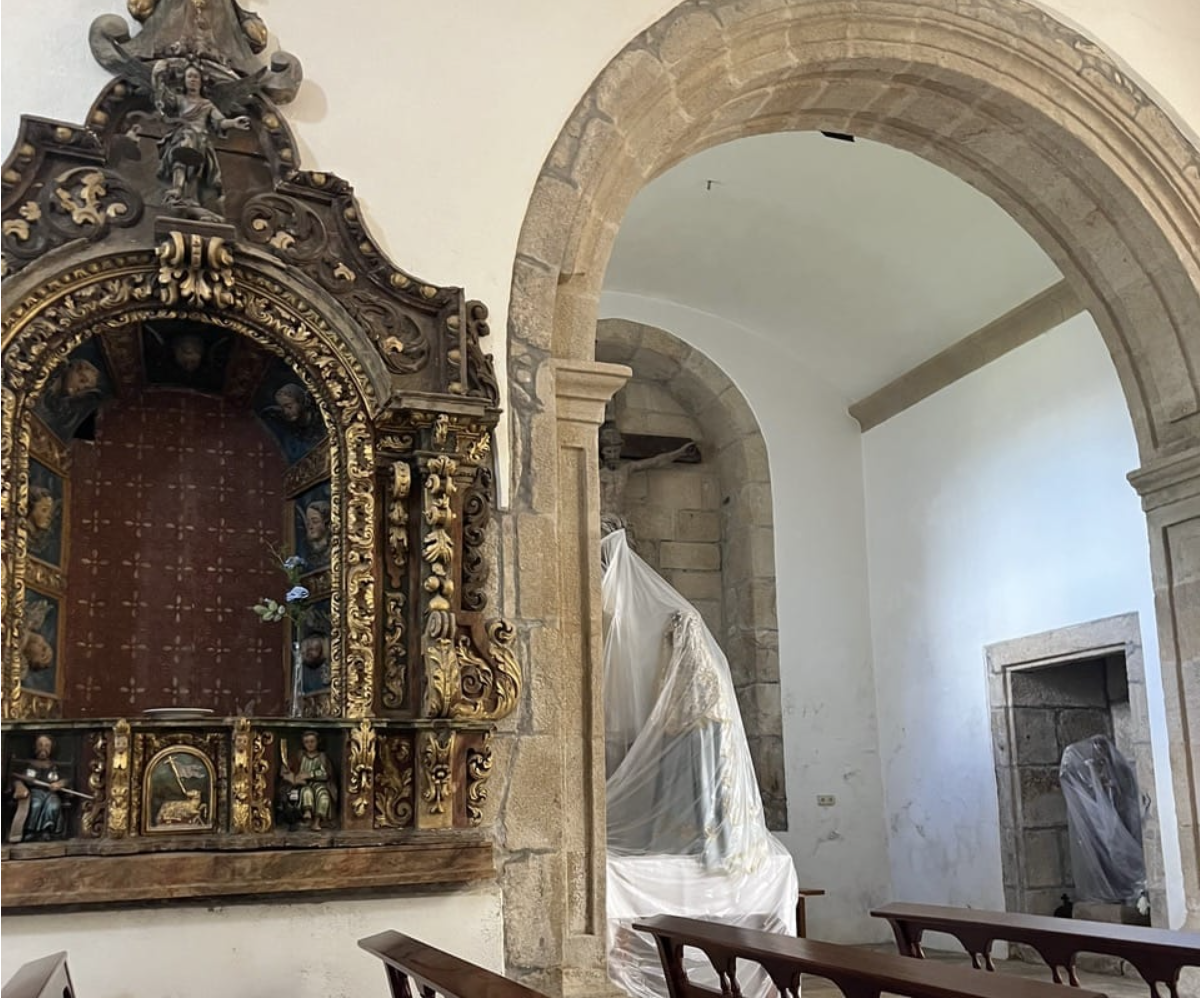
At mile 13 I step off the path towards a spire, down steps into a graveyard and into a chapel. Inside a man and a woman with gloves and masks on are doing conservation work. All the statues have been shrouded in polythene and the chapel smells of turps. I try to pray while watching the conservationist high up on scaffolding behind the altar, brushing the cherubims and apostles with tiny tools. It hurts to breathe in the chemical air. The prayers do not come to me against the precise tap tap of their work.
The walk felt so long but also like nothing at all. Legs heavy, I felt them stretch as I rolled my foot through from ball to toe. Face, hands, all of me sticky with sweat throughout. I am walking to be alive, to hold myself and the joy I have, after almost not being. My near death in the hospital; killing of my life in the heartbreak. Hours of thinking nothing slip into each other with the tramp of a hill climb, just looking and naming. Hollyhock, walnut, pine, wild geranium. Bind weed and grapevine after grapevine. But still, also, all the sorrow sits heavy, my throat constricting at the ghost of the tubes that were keeping me breathing three and a half weeks ago. Then there’s the sorrow of my chest cracking open with the new heartbreak, prodding at the old heartbreak. All these heavinesses I’m holding swallow me up so I lean on litanies, the walking, and gripping, re-gripping.
**
Hospital
Whole days had stretched out where she couldn’t see beyond the end of the hospital bed and the edges of her unbound pain. Pushing feet against the plastic footboard, begging for pain relief and opioids. Her mother dipped a metal spoon in iced water, rolling the bowl of it across her forehead again and again and again. Fear of the pain of water near her mouth, her cut-up throat. Everything felt repeated, each lifting of arm for blood pressures had already happened. Each touch was the touch now but all the past days of it too. Someone taking her hand took her hand alongside every other time someone had taken her hand - and would take her hand - for the rest of the stay of this pain. Her hand her mouth her arm was not her own, pain measured and recorded in numbers and dosages and hours, in the slow quick cold flush of water through cannula up wrist, down back of nose down feeding tubes, medicine pushed through, bloods taken. Bruises on her belly again from injections.
Eyes could not see the ICU, could not focus, stay open, see past the periphery. A nurse on a swivelling chair, monitors. The monitors were her vitals, she was hooked up and fed into these banks of data. Each collapse triggered alarms and bleeps, brought more nurses, doctors, lifted and bundled, her name her name can you hear us, can you open your eyes, can you look at me, squeeze my hand. Other hands attaching the ECG machine to chest, torso, crooked arms, avoiding the cannulas.
There is a photo of her, cheeks and lips bruised and puffed up, tears under the tubes across her face. She remembers sobbing and screaming and begging. Hallucinations had crowded into her, nurses as crows, all beaks and black feathers, rushing forward in a perpetual swoop, never reaching the bed. A dog barked out of sight repeatedly, a baby gaggled. She asked hours, days later, is there a baby on the ward, is there a baby here.
***
Restaurant
In Oxachegou Restaurant they recommend me a wine and now I have a little bowl of soup. Clear liquid, cabbage and the husk of white beans, their insides somewhere in the broth. The soup is so hot and so salty. I discover butter-yellow potatoes in the soup. They are perfect. Boys outside are smoking, their thick chorizo sandwiches going cold.
The waiter gives me the tiniest fork. Inside of me I ask, why do so many Spanish men have big earrings, goatee beards, heavy metal slogan t-shirts and camo shorts.
Inside the restaurant there are only four tables but the voices echo.
I am eating squid with more delicious yellow potatoes. The salad is plain, the dressing vinegary. I feel myself wishing I had ordered the anchovies.
But the squid is good. I am glad I got the squid. I forgot to get peaches for breakfast. It is ten past ten. My mind flits between the two men I’ve lost; which I wish I could share some of this with. It’s fleeting though, I shake myself free, grip it for myself again. The former because of habit, because of having occupied spaces like this together. The latter, the newer, has more joy to it, it is full of beauty.
I am suddenly so weary.
**
Cathedral
The cathedral was so much gold; huge pale-faced smiling angels holding up thick wedges of gold, with a temple, layers and layers more gold on top, heaving with statuettes. The priest kept coughing. The familiar mass lilted in unfamiliar Spanish. The cadence felt like that of Lord, I am not ready to receive you, but only say the word and I shall be healed. I asked myself, will I be healed by this. I did not know but when I prayed the words came easy. My words to God were not a desperate plea, not starting from the bottom, rather crying out from part way up the ladder. Asking for help for the climb I was already making.
Nothing of the service I understood. The cathedral was grotesque in its obtuse gold, angels, gilt, weight. Beside this the priests and nuns were small. Not understanding the words stripped back the rote and familiar, and I saw the faith in those speaking at the altar, those genuflecting around me. Beside me a woman held up the psalms on her phone, in German. I thought of the story of Babel, how I had not understood as a child why God would do this. I am still not sure I understand the idea of languages. How the words around me that I can’t speak are conveying the same meanings as the ones that I can.
At peace be with you everyone turned and spoke it in their own words and my heart brimmed. I thought of the moss on the tree yesterday, 10 miles in. The sunlight, placing a hand there, my rings, the sweat, feeling God.
**
Heartbreak I
She hadn’t had her heart broken since she was 21. Almost a decade ago, most of her adult life. She’d wept over lost loves, but as a sadness with acceptance. This felt like constantly caving in further and further even though there was nothing to cave into anymore. Inside she was a hollow cavity, with no way to fill it back up again.
The sadness was thick and heavy, crushed her. She had left the little flat on the top of the hill where they’d lived for years, stuffed her car with all the things she could, and drove down to Cornwall. She took her papier mache hare, the fern she’d had since lockdown, just as they’d met. Candles, a lamp, their radio alarm clock. Each day had a hundred different layers of sadness, of opening the car boot and feeling the tumbling toppling of her life and heart and stomach and tears down her face, as she felt around in crates and bags for fragments of her existence. Hardly able to breathe. Trying so hard.
When her heart was broken she lost the understanding of her life, the shape of her days and nights.
**
Breakfast
In the Cafetiera Paradiso eating Tarta de Santiago. It is all old smoked glass mirrors, carved wood fruits. The tart is dense, large bits of almond.
My mother texted, it sounds like you are having the most fulfilling and self-affirming time. I did not feel this to be true. It is a time, yes, a good time, a quiet time.
I drop icing sugar on my book. A man in a soft linen shirt spreads olive oil on his toast.
**
Beach, near Rianxo
I am risking the last bus back, trusting the internet. Eating anchovies and cheese and yesterday’s bread, letting the oil run down my hands, smear across my mouth. The soles of my feet are burning. There is so much time to think. I have postcards in a paper bag with roses on to write. Anything black is hot and my chest is slick with sweat.
Earlier in the hot square I said, is it tarjeta in Spanish. My words come out as a mix of French and Italian, Spanish the least familiar. I did not know I knew this many words, a patchwork tongue. My face is burning and I need to piss.
Here on this trip I am barely speaking.
I send voice notes to Molly and my mother. Brief interludes, a handful of minutes in the long hours of a day. Spanish so broken it is just words does not feel like speaking.
**
Heartbreak II
This one had twisted her up inside. The fresh hurt almost sweet in realising she could hurt anew. This man’s kisses had such gracious beauty to them. When she had left the hospital, they’d walked around the fence of Southwark Cathedral, trying to get in as the bells pealed out. They’d stood staring up at a mulberry tree whose boughs came down almost to the pavement, pointing out the fruits beginning to ripen already. They’d gone into Guy’s Chapel, with peeling paint and white and pale blue piping and a choral practice underway. She’d sat on the royal blue steps to listen, he’d steered her up to the balcony.
She’d turned her head to see out the window at an old tower block and the lip of Victorian square and panes of window sky and wept with the music. She wept for herself, for feeling so lost and not knowing who she was. He’d held her hand and gripped her shoulder and his touch was hot and sweaty and their fingers didn’t fit perfectly together but there was so much care. To have had to let this man go ate into her heart.
**
Breakfast
Today’s Tarta de Santiago is flatter, less cake-like. Crumbling with tiny bits of almond, the top crisp. Yesterday I texted a boy, talked about ‘the good life’ and cherry jam, talked of capacity as something that can be expanded. Whether to sit within your capacity is to limit oneself, to stop striving.
My heart today sits so different to yesterday’s heart. On the beach I had swam round sloping rocks, gone barefoot along forest cliff paths. Stumbled smiling through ‘ice’ in Spanish at the kiosk, drank beers listening to Van Morrison. I got ash in my mouth and did a shit in the sea. Ate tomatoes like apples, crouched over rock pools to wash sticky hands. The bus journey back was filled with the warm glow of 9pm and mountain roads. I listened to Amy MacDonald and felt tingling with life.
Today listlessness creeps into my flesh. This morning I have the blues, dreams of both men and miscarriages. The pushing through taking its weary toll. I bought a hot chocolate from the vending machine for 1.20$, a little brown plastic cup. Sat on steps with hazelnuts, the last of the mist burning off. I cannot eat just sweets.
**
Mass
Pilgrims are streaming down every street. It is 10am and is already hot. I am sweating. Today for the first time I spoke to another pilgrim. He was from Romford, had walked from Fatima, starting a month ago. I notice the involuntary thoughts of throat closing, breathing stopping, tubes feeding, heart breaking, seem to be changing. Before they sat briefly within me before cutting out, but now they are hurting again. I take this to mean (I want this to mean) that they are breaking out of me. An exorcism. I had let them sit like demons, accepting. Now I am consigning them to prayers, throwing them away from myself. So they are surging up, fighting back.
At the Pilgrim’s Office they have a mass in English. I go on my last day, sit in a pew with a ray of sunshine straight in my eyes. The Pilgrims’ Chapel is square and sparse, but filled with volunteers in green tops and people speaking English. Almost immediately my eyes start leaking. The priest asks each pilgrim to share their name, where they’ve come from, and where they started their camino. Here I could speak but cannot. I did not start anywhere. The hymns come with a backing track playing off a portable CD player. My voice is still so small after the surgery. I sing and sing and crack and crack and by the last hymn I am heaving with sobs and I can barely breathe. The mass ends, thanks be to God, go in peace.
**
At the airport, I learn from the internet that those raised granite buildings are not shrines but horreos, grain barns, corncribs. I am looking forward to being able to speak again.
Elizabeth is a writer, researcher and programmer. In her research she explores distinctions between class and taste, through the lens of rural traditions and craft practices. Her rural upbringing is woven into aspects of her work: decoding and unravelling mythologised and idealised depictions of reality while celebrating the ordinary and the everyday.Elizabeth develops the public programme at Staffordshire St, a project space in Peckham, London. Her writing has appeared in Food& magazine, Gut Feeling Anthology, the Content Journal, Page of Wands, ROAM (upcoming) and has been performed at Edinburgh Fringe Festival. She also runs Folk Club, exploring the folklore of Albion.