A Star Is Born: Winners of the Ninth Heaven Summer Short Story Competition
The winning and shortlisted stories from Ninth Heaven's first Summer Short Story Competition — with the editor's foreword, the judge's selections, and the full anthology, “A Star Is Born.”
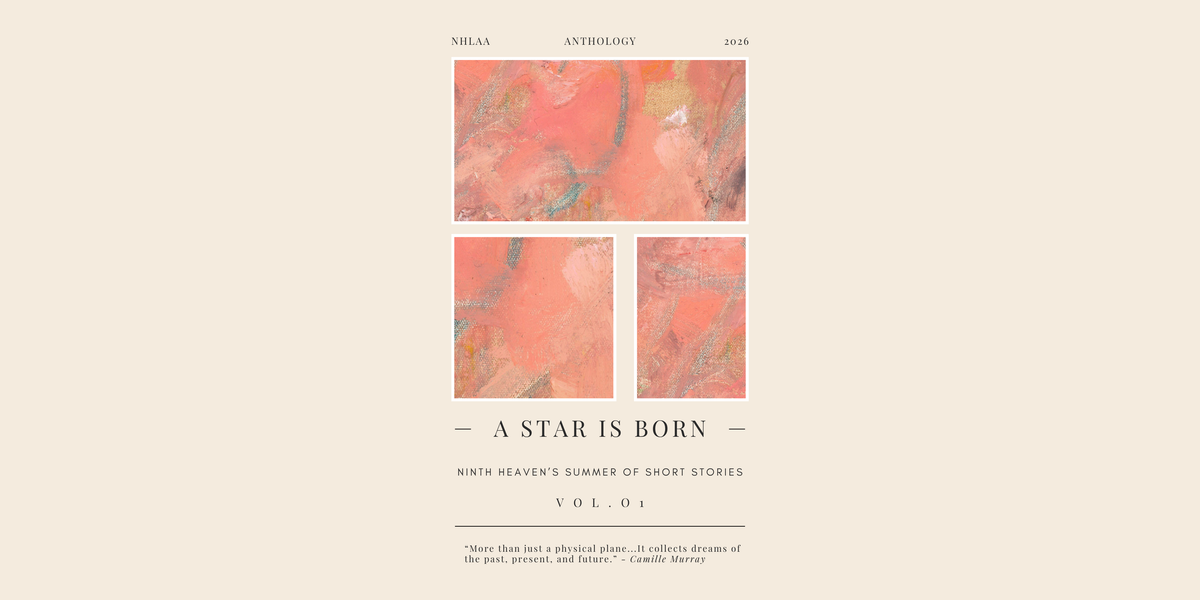
“More than just a physical plane… It collects dreams of the past, present, and future.”
— Camille Murray
Foreword
NHLAA has much to be proud of in its first year of incorporation. Collaborations with global academics, hundreds of submissions, and the digital publication of its first journal, to name a few. Yet I think the launch and subsequent anthologising of the Ninth Heaven Summer Short Story Competition, marks a substantial turn towards the local and the material. Where NHLAA has had most of its applicants come from various parts of the globe and all its publications digital, the NH Short Story Competition featured nearly 70% Australian writers and will be the first physically distributed Ninth Heaven work.
It also marks a turn to the more literary. Prior to the NH Short Story Competition, NHLAA mostly published poetry, philosophic and cultural essays, and occasionally some art works. This change has meant that the scope of stories received were quite diverse, ranging from episodic ruminations on fleeting relationships and experimental works engaged with Proust, to comedically neurotic pieces about jigsaw puzzles, and prose poetry pieces about the future life of a man on his way to work. As with all things, it is good to begin with our relationship to God. When I set out to initiate this competition, I had in mind that the arts are always an exemplification (and often an exploration) of Beauty; and that it is through Beauty—corporeal and worldly Beauty—that we come to know incorporeal and other-worldly Beauty.
While the views of those in Ninth Heaven may vary on what Beauty is, how it manifests and by what means it moves in the world, and while those views are certainly varied in the applicants and in the contents of the anthologised short stories, the through-line, in the selection of winners and initiation of the Short Story Competition, as well as in the publication of essays and poetry in Ninth Heaven’s broader work, is the veneration of Beauty. A veneration of the life that inspirits all matter.
Thank you to Nicholas Andreyev, Nicholas Osiowy and Joshua Pipkins, who were enormous contributors when it came to first and second rounds of judging, and to Dr. Craig Billingham, who selected the top three stories of the competition, and who has given continued encouragement for the running of the competition. Thank you to Anaïs Grant for the creation of the cover art, and to Chukwudiebube Ajaero and Chidinma Nwanoka for the design of the anthology on such short notice. Thank you to the Directors of Ninth Heaven, to the Advisory Board and the NHLAA team who have built such an incredible environment of which this competition and publication forms only a small fraction. And, of course, thank you to all the applicants to the NH Short Story Competition. It would not matter in the slightest what the publishing world did, what connoisseurs preferred, and what consumers desired, if there were no artists, who, before anything else, loved to create beautiful things.
Masashige Akioka
Editor-in-Chief,
Ninth Heaven Literary & Art Journal
The Competition
The Ninth Heaven Short Story Competition was founded to honour serious literary work, fiction that earns its place through precision of language, integrity of form and content, and sustained imaginative and fruitful commitment. This year, the competition received more than two hundred submissions, drawing from a wide range of voices and approaches to the short story.
Submissions passed through a structured reading process comprising preliminary review, shortlisting, and final adjudication by the appointed judge. A total prize fund of one thousand dollars was awarded across the major prizes. The Association thanks every writer who submitted their work and entrusted this process with something of their own making.
Prize Winners
- First Prize ($700) — In You, A Star Is Born and…, Masha Kurbatova
- Second Prize ($200) — A Missing Piece, Stella Weston-Davis
- Early Bird Prize ($100) — Work Nights, Theodore Heil
Shortlisted Writers
Borderlines, Matthew Southwell
What Language Will Not Meet Me With Rust?, Camille Murray
Judge
Dr Craig Billingham
Sponsors
The Ninth Heaven Literature & Arts Association extends its sincere thanks to the Andreyev Family, whose generous support made this competition and its publication possible.
In You, A Star Is Born and…
Masha Kurbatova
The Californian rock band Red Hot Chili Peppers have millions of fans worldwide. Many fans claim to be number one. They think there is no real metric to measure their claim, and so they falsely assume the title, figuring no one can outstrip them of their crown. But they’re wrong. Red Hot Chili Peppers do have a true, uncontested number one fan. He lives in Samara, a city on the banks of the Volga River. Every day he crams like a canned pea into a marshrutka minibus en route to the aluminium plant with a CD player leaking Californication’s fuzzed basslines from peeling headphones. He can’t speak English well and certainly can’t understand the Peppers’ hypnotic alliterative druggy spitting lyrics. But he understands funk, and rock ’n’ roll. He’d skipped school to DJ on a party boat, splitting the Volga with its white hull—he knows what makes people jump and bump. Now an adult with a working knowledge of the nascent computers rewiring post-USSR Samara, he goes to his IT job at the aluminium plant and drums his jeans to scratched American CDs, as a whole marshrutka packed elbow to elbow with old ladies drowning in their coats glares at him. Years later, he will become my father. For now, he watches snow smear mud outside the window. Red Hot Chili Peppers’ number one fan is half an orphan. Has been since adolescence. His father exploded in a rocket just past Earth’s orbit. His mother called and called and called the school when she’d learnt. The school said, we don’t know where your son is. (He’d been on a boat then, spinning records, half-noticing the tight-jean blonde-haired imported-lipstick perfumed flock bobbing along like seagulls). His father, the astronaut—sorry, cosmonaut—technically died a hero. But the mission was secret, and so were the casualties. Bright daylight cancelled out the explosion’s lights. No one noticed. Nothing was reported. No one remembered. His father left for space from a city called Kuybyshev. Since ’91, it’s called Samara.
His father taught at Samara State Aerospace University. Lectured to a dull-eyed dry-mouthed classroom carving their names into their desks. His students didn’t know their university would decades later merge with Samara State, form a big, bloated institution, later renamed Samara University. His father knew the students had heads full of sawdust. Except one—she was promising, alert and brown-haired and sharp-nosed, with her head up and pen moving. Years later, in the same nation bearing a new name, at a party where someone else, for once, was spinning records, she will meet my father. A year later, they will marry.
This woman my father will meet reeks of ambition. The American man in the scholarship interview will smell it wafting off her Soviet-era brown jacket sewn back together again and again with clean tight stitches. His job: parcelling out bits of billionaire’s earmarked philanthropy funds to send promising international students to internships in Europe and America. Her application, he’ll sift into a different, slimmer pile. When she stands to leave, screeching back her chair, he’ll notice a bump above her ill-fitting black office pants. She’s pregnant with me. His fingertips will linger briefly above the paper form: pregnant students have higher drop-out rates. But then she’ll shake his hand so confidently (Americans respect a strong handshake). He’ll forward her application to his superiors. She’ll be approved for funding.
She knows scholarship recipients don’t choose where they intern. Still, she’ll look to the cosmos—for New York, Vienna, Paris. She wants to see California. The letter comes: she’ll be leaving her husband and newborn son behind for a year to live in Huntsville, Alabama, USA. She cries and cries and cries. Still, she leaves.
I’ll be born with weak eyes and tender eardrums and a belly full of static. My mother will work in America, my father will punch a computer at the aluminium plant, his mother will bottle formula into my mouth. Part-time, my grandmother teaches Chemistry at Samara State Aerospace University. She misses her dead husband and the students she’d once seen so much of. The full beam of her love will redirect to the colicky infant leaving islands of saliva on her blouses. When my father returns from work to the apartment crammed with rugs and rickety furniture and battered bald stuffed animals, he’ll bathe it blue in television light. He’ll watch sketch comedy splayed on a pull-out sofa, me naked and stomach-down atop his bared torso, the warmth of skin-on-skin loosening the knots inside my belly. This is the only time I’ll stop crying. The only technique. He’ll try playing rock ’n’ roll for me (funk lullabies) but it’ll razor through my malformed ears.
They say babies are psychic sponges. The film between them and the world is watery. Their soupy brains collect sensations, vibes, images, store them inside a soft skull yet uncrowded by words. I’d like to imagine that lying there with my father, in a dark dusty apartment in Samara, me squirming in pain—and remember, to a baby, every new pain is the worst pain they’ve ever felt, worthy of a scream—I’ll absorb everything around me: the university-kid comedians on TV shrieking shrilly and doing flips and accents and wearing parrot-bright costumes, the soft laugh they summoned from my father, how his stomach shook beneath mine. I’d like to imagine that there, my unshaped brain will begin contorting itself towards comedy.
My first birthday, my mother will return for. She’ll be different. Bleach and dye will strip the brown from her hair. Her voice will carry new, American inflections. A mean spark in her eye. She’ll whisper to my father about emigration. He’ll watch me play with our newest luxury: an in-home computer. I’ll bang on bulky beige keys, my pinprick fingerprints greasing its bulging screen. My father will point to the digital white page I’d left lines of gibberish on. He’ll point and laugh—the first joke I ever wrote. He’ll think my mother wrong. Things were bad in the 90s and will be bad in the 2010s and even worse in the 2020s, but for now, in the 00s, everything’s okay and fine. He’ll see no reason to leave.
My mother’s university monthly stipend will afford perhaps one pack of Pampers. The winter sunset always summons the season’s depression. Some secret sense will usher her to leave. Her ambition will leak from her pores; leave wet prints on every paper she touches. She’ll fill out more applications, put us on an airplane. Layover in Frankfurt. Next stop, America. My father has a fear of flying. The air seems so unstable to him. When we shakingly rumble above the runway, he’ll close his eyes and hum the ‘Can’t Stop’ bassline. The pressure changes will burst my little eardrums. I’ll scream scream scream.
And so, we’ll be in Huntsville. My parents will try to raise a genius. Someone who knows rockets. Like my mother, or my grandfather. Someone who knows computers, like my father. But I’ll fall asleep in every Kids That Code meeting, be too shy and shaking for Space Camp. The bright burn of computer screens will cut my weak retinas. Then they’ll try for more American forms of brilliance, but acid-fire stomach aches will make me miss too many days of football and soccer and lacrosse practice. My only fun summer, I’ll spend at Circus Camp. My parents, bleary-eyed, work-weary, will strain into smiles at that summer’s final camp performance where, in a high school’s shoe-stinking gym, I’ll smear pie into another kid-clown’s face.
I’ll grow into a spoiled American teenager. I’ll say cliche American teenager things, like “I hate you!” or “You don’t know me!”. I’ll cut class to smoke beneath hot-metal bleachers. I’ll groan for days in bed, stomach bile leaking back up my oesophagus, watching sketch comedy as distraction from the sharp glass in my guts. I’ll think my father has the worst, corniest music taste in the world, and I’ll say it to his face.
Still, my parents will love me. Still, they’ll buy me anything I want. When small rips streak my jacket’s sleeves, my mother will throw them away and buy new ones. In America, she’ll refuse to ever sew another garment back together. Secretly, she still hopes I’ll consider becoming an engineer, or something equally impressive. When I announce during dinner at 18 that I’ll become a comedian, she’ll let a slow stream of air hiss out of her lips, balloon deflating. My father will sigh, secretly relieved, that my ambitions don’t fly high, that I care most about being happy.
I’ll drift through college. I’ll miss classes, nursing a sick stomach that I still flood with beer. I’ll never do homework. I’ll only write for my sketches. I’ll develop my comedic character: The Astronaut. He’ll be built mostly on physical bits, on-the-nose allusions to that silent film where the rocket flies into the moon’s eyeball, with some fake-moonlanding jokes strewn in. I’ll perform at college open mics to lukewarm reception. Still, my ambition will grow. I’ll imagine myself a star. I’ll change my name to something easier for other Americans to pronounce.
In my mid-twenties, I’ll have a realisation: my parents are people. They’ve had whole lives before me. This realisation will crack me so wholly open that I spend seven straight days crying in bed, my eardrums popping, my eyes red and blurred and swollen. I’ll want to do something nice for them. I’ll decide to buy them something grand and expensive to show my love. I’ll book a black box theater at the very edge of town, do my one-man comedy show, intending to collect some excess cash. I’ll perform to an audience of eight people, one of them, my father (my mother will have a work meeting that night). His laugh will be the loudest. Fees for renting the theatre will eat away my entire night’s earnings.
The day after, my mother will book concert tickets. Red Hot Chili Peppers are on tour. I’ll accept half-heartedly my parents’ invitation to come with them. It’ll be over two hundred dollars for each ticket; my mother will pay for me. The stadium will be so crowded: escalators between floors packed with bodies seeping sweat, merch lines snaking past several corners, bathroom stalls swinging open and closed and open and closed. My father will try to buy me a beer; I insist I’ll pay. We’ll take our seats, and he’ll shed tears into his overpriced and foamy cup. I won’t quite understand why. The stadium opens to the sky, and we’ll see many satellites wink above the stage soon to house the Red Hot Chili Peppers.
But that’s all in the future. For now, it’s 1999 in Samara. My father rides the marshrutka, its passengers pressed knee to knee. His scratched CD skips. He’s sweating in his winter coat. He’s yawning—he doesn’t want to go to work. He looks outside: a world white with snow.
A Missing Piece
Stella Weston-Davis
“Anxiety can be replaced only by the freedom whose harsh requirements are its cause.”
— Søren Kierkegaard, The Concept of Anxiety, 1844
“It will be like finding a needle in a haystack.”
— Saw II, 2005
It was a little past midnight when Ernest started to think that he had lost a puzzle piece. His mind had been meandering between ideas of what to cook for dinner the next evening when Holly’s parents came by (a curry, he had thought, though they were rather conservative with their tastes and it was probably safer to make something more pabulum), to that moment from when he was twelve and tripped over his shoelaces stepping up onto the bus and everyone laughed, to Holly lying next to him, wrapped up in almost all of their lightweight quilt, and then, suddenly, the puzzle.
It was one of those things he hadn’t considered before and was consciously aware of that being the case. A person would never purposely lose a single piece of a puzzle, except maybe to maliciously taunt someone. He himself had once stolen every single Queen from the deck of his older brother after he had stayed up late playing poker with some friends, and Ernest had gotten no sleep. But to lose just one puzzle piece was much more abominable, because it was harder to replace. At least a deck was anodyne; for a puzzle, you’d have to buy the whole set again, and there were just too many pieces to know for certain if it was only one missing, unless you built the whole thing, which would circle around to being a reminder of the one that was missing in the first place.
They had a few puzzles, Ernest and Holly, most of them bought from foreign countries on their travels, displaying wide swaths of coastlines or mountainscapes native to their point of purchase. The puzzle in question that was arousing such thoughts was from Egypt, a thousandpiece set brandishing the Pyramids of Giza in all their sandy glory. He remembered buying it clearly, from a sandstone gift shop towards the end of their guided tour. The store had been filled with the same types of souvenirs you could find anywhere in the world, shelves of tacky magnets and photographic postcards, t-shirts printed with ‘I Heart Egypt’, and a collection of puzzles. It had become a ritual to always pick up a puzzle when they travelled. At the counter, Ernest had worried he was being overcharged for the set, still not quite used to the mental conversion rate into Egyptian Pounds, but he had still bought it and politely tipped their tour guide the change he got, to which he received a louche smile. Ernest had never finished the puzzle, though he had attempted it once or twice, only to have to pack it up before completion to make room on the kitchen table for dinner. Its incompletion worried him even more—how could he know that they’d ever had all the pieces in the first place? What if they had lost one while still in Egypt? Had they opened the box before they brought it home, or was it possible that one had disappeared in the hull of the plane, sliding out of a crack in his suitcase zipper? Then he’d truly never find it again.
By now, he was obstinate that something was missing from the set, but he reasoned that it would make no difference whether he looked now or in the morning. Holly wouldn’t be quite so amused to find him crouched over the table, counting puzzle pieces in a tally book to make sure there were exactly a thousand at this kind of hour, interrupting her limited beauty sleep. She’d ask why he cared so much; the puzzle had been untouched for months, then some sort of joke about how ‘puzzled’ she was by his behaviour – she was always a comedian. He could wait until the morning.
He could even make himself a cup of coffee before he sat down to count, maybe put on some nice music, too, make a morning out of it, it was the weekend after all.
Though now he thought about it, he worried that the music would distract him and he’d lose count of how many pieces he had counted and have to start all over again, or that he would have too much coffee and his fingers would shake. He might even spill the coffee all over the set; the cardboard was only so thick, and it could fall apart under the pressure of a blistering liquid. Maybe it was for the best that he did it in silence. And, of course, he’d have to lock Dolly in a separate room; she would come sniffing and wagging and could very well eat a piece, then he’d only get it back in an unusable state, if at all. He wondered if cardboard disintegrated inside a dog's stomach, even if it was just a scant one like Dolly, whose intestinal tract must be smaller than that of the average canine. Would the plastic print holding on the image to the cardboard have any effect on the digestive process? It was all very stressful to think about, so many unknowns – what chemicals were inside the pieces? Could they leak out, hiding like a sleeper agent inside Dolly? She needed to be in a different room.
On the thought of other rooms, he’d probably have to shut the doors to the bedroom, too. The window in here was large, and in the summer, Holly liked to leave it open to freshen up the place, but it did let a breeze into the apartment, which was dangerous to such weightless things as puzzle pieces.
If the wind blew one off the table, it could fall into the cracks in the floorboards that Ernest always drifted his toes across at dinner. A piece so small would most certainly get stuck in the gap; it’d bend by the force of trying to get it out, and then the whole thing wouldn’t fit together anymore, which was just as bad as missing a piece altogether. That settled it; he would lock the bedroom door, as well as the laundry door with Dolly inside, because if she were locked in the bedroom, then she might pee on the carpet again, and Holly would be so upset, and they’d need to get it dry-cleaned for the second time that year. Ernest was happy with his plan; nothing else could be a risk to getting to the bottom of this puzzle, and so he turned over and tried to fall asleep.
Ernest thought, half-heartedly, about which was worse: to have lost just one piece or more like three or four. He really did wish he could get to sleep, but the concept just kept provoking him. If it were a couple of pieces, he could accept a lost cause. There would be empty patches all over, which would be pointless. It'd take twice as long to finish, especially if he was missing an edge piece, or God forbid, a corner. These were the fundamentals of any set; it would all be fruitless. He decided that just one piece was worse, because you wouldn’t notice until the very end. All these thoughts pestered him, and he knew there was no point trying to sleep now. He could sneak out of the room quietly, under the guise of going to the bathroom, if Holly mumbled at him, and just quickly check the set. It really wouldn’t take that long; if he didn’t do it, he would be lying here just as long, counting hypothetical sheep in his head. It was the most efficient move.
Ernest slipped out from his meagre quarter of the covers, taking care not to tread on the wooden panel at the end of the bed that always creaked under his weight (it wouldn’t creak when Holly walked over it, which did make him a little self-conscious about gaining a few pounds). Dolly lay curled up inside the dip in the blanket between Holly’s legs, though she gave a bit of a ruffle when he tiptoed past, which gave him pause. She eventually settled back down, and Ernest continued his path. The puzzle was stored on a shelf in their study, which was the room furthest in the apartment from the bedroom, though it lacked the table space for him to appropriately catalogue the number of pieces, so he’d have to move it back out to the dining area to count it. He crept across the hallway with more intentional precision than he ever had previously, aware of even the crude rustle from the fabric of his shorts' legs moving against each other. He felt much like a spy or a young child doing something that they knew their parents would be disappointed in. As he passed through the kitchen, the moonlight gazed into the window and landed itself onto the left side of the dining table – perfect, Ernest thought, it would provide a light to work from without worrying about waking up the girls. The puzzle was exactly where he had anticipated it being, second from the top of their pile of board games and other puzzles, just beneath Monopoly and a stack of unused printer papers, loose and haphazard. Ernest moved them all with the quiet patience that his journey had been made up of, careful not to let any drop to the floor or get bent. The Monopoly set rattled as he moved it, muffled pewter clanging. Finally, he got his hands on the puzzle. It was as he remembered it, a remarkably unremarkable puzzle set that would undoubtedly end up at some second-hand store like so many did, discarded for lacking totality. Ernest mentally prayed that it wouldn’t have to come to that.
He brought the set out to the kitchen, placing it onto the table and sliding the lid off with nimble fingers. The picture on the cover of the box looked at him tauntingly, like it was daring him to figure out which portion of the image was absent. The big ‘1000’ sat next to it, teasing him with its wholeness. He flipped it over in disregard and began counting the pieces slowly, placing the ones he had already counted into neat piles of ten to his right side.
As the toll grew higher, the moon gained a warm attitude, but Ernest was engrossed, double-checking every few stacks that he was at the right point in his counting. He dreaded the end, when he would know for certain if he had the total amount, because then he would have to decide if he wanted to build the set to identify the absence, or give up and discard, its offence too much even for its sentimentality. He was nearing the nine-hundreds now, and a pleasant pile still sat waiting for their counting. He had some hope, for the first time that evening. Maybe it was simply some strange paranoia that had captured him in his sleepless mind. The numbers raised in polite support of his optimism— nine-hundred-and-seventy-eight, nine-hundred-and-seventy-nine…
It was only at nine-hundred-and-ninety-five that Ernest looked back at his uncounted pile and puzzled.
He stood with none of the subtlety of his arrival and tracked back to the bedroom, Dolly raising her head, hopeful of some surprise early breakfast. He moved to his side of the bed and grabbed his phone, which turned itself on at full brightness. At the emblazoning device, Holly petered out of sleep, wiping her crisp lashes and staring somnambulantly at Ernest, who was too engrossed in figuring out his dilemma to notice her.
With vociferous fingers and sallow eyes, he typed into the search bar, white screen creating a dull reflected rectangle in his pupils:
‘Do 1000-piece puzzles have exactly 1000 pieces?’
Work Nights
Theodore Heil
The days were all the same. It was the year of unemployment. The year of debt. Burning through savings. I took a lot of jobs on. I wouldn’t call them odd. For a moment, I worked at a concession stand. For longer, I was trained to guide tourists around the island with a little flag. I climbed ladders. I excavated headphones from subway grates. I fell asleep on the train with my coffee cup out. For all this, I was given dimes.
I was working at a magazine. I was on my computer most of the time. I took down names. I was paid very little for this. But everyone told me it was good. You’re Doing Good Work. I met some people. They were all interesting. There was a woman who only wore blond wigs of various lengths. Another, an intern, told me she had received a nose job as a graduation present. From College or High School? I asked. Junior High, she said. I was reading too many names. It hurt my brain. I wanted to read books, not names. I quit soon after that. I cleaned out my cubicle. I brought my own cardboard box to put the little things I kept on my desk. Mostly, I surrounded myself with pictures. To work at a magazine, I had thought, you had to think like a magazine. Everyone seemed glad that I was going. It occurred to me I was the only person in the office who had not had a rhinoplasty nor entertained the idea of getting a rhinoplasty. Even the intern ignored me as I left. I pressed the elevator button to descend forty floors.
In my friend’s apartment building, I met a girl whose name was Honeypot. She was very normal. At a bookstore, I met a boy whose name was Seth. He was not. We all drank together. We went to Chinatown. We stole dumplings off each other’s plates. I was dazed so I thought it was an allegory. Or like an allegory. Seth told Honeypot and I the story of the student and the bartender. There was a student and a bartender. The student couldn’t afford to eat at the bartender’s restaurant. So, he ordered a beer and brought his gruel. The smell of the food was enough for him. He ate his gruel and, with the smell, it was like he was eating a large hearty meal. The bartender was livid when he found out. He brought the student to court. The judge hemmed and hawed. Very Well, Seth had said. He was wearing the judge’s voice. To Repay His Debt, He Will Drop One Coin Over And Over Into Your Till; The Sound Of A Coin Hitting The Cash Box Is To A Money Handler The Equivalent Of The Smell Of Good Food To A Hungry Student. It made me think of myself. I stole a dumpling off Seth’s plate. Honeypot stole a dumpling off mine. Seth stole one from Honeypot. We were an M.C. Escher painting. We left the restaurant without paying. We did this every day for a month until Seth disappeared. Honeypot and I stopped talking after that. We think he ran away to Portland. Maine.
For $300, I scanned documents for a journalist with my phone camera. They were boxes of journals. From a psychoanalyst. I separated the scans into computer files. The files were contained in white and black boxes. No bigger than my thumbnail. The boxes were numerous. So were the journals. The journalist’s house was very large. Big windows like a church. A chandelier. My phone overheated. My phone stopped working. The battery corroded. I used to sleep with my phone. I used to sleep with two pillows. My phone’s battery corroded and leaked out the sides. It leaked onto my pillow. The pillow corroded. There was a melting yellow hole. I threw out my pillow, my phone. I slept with one pillow. I still have the scans. The psychoanalyst wrote a lot. I wasn’t writing at all. There were more boxes to scan. They were at a monastery. Email Me When The Article Comes Out, I told the journalist. Okay, I Will, I Couldn’t Have Done This Without You, she said. I didn’t hear anything from her.
I went to the beach. I rode the train all the way to the last stop. Because I didn’t have my phone, I couldn’t find my way to the water. But I smelled it.
The summer was still cold. The next day, the amusement park would be open. I sat on the sand without a towel or blanket. I sunk my toes in. I did mostly everything I was supposed to do. I stepped into the ocean. I knew that I was supposed to feel the grandeur of the natural world. I knew this because I read books about it all my life. There was even a book where a woman walks into the ocean because… Why? I had totally forgotten. I only had the feeling, which was more powerful than memory.
I saw the journalist’s husband on a work lunch with one of his employees. She seemed familiar. We were at a diner with mirrors on all the walls. I watched the journalist’s husband and the lady talk over their burgers. He was drinking black coffee. She had hers with cream. Their hands never brushed. They were polite, using their inside voices. The journalist’s husband had a laugh like a bark. The lady demurred. I watched them for a while. He paid his tab and they walked past my table. I looked down. I hadn’t hid my face well.
For a while, Seth and I had an awkward friendship. We met because I had been standing in the bookstore reading for an hour. I didn’t want to buy the book. I didn’t want to steal it. I wanted to stand. I wanted to finish the book while standing. I don’t know how Seth and I began to talk. The last time we caught up was at my apartment. We were sitting on the couch on opposite ends. The television light flickered too brightly. The house was filled with the smell of burnt popcorn. It felt like it would spread. I moved carefully. My eyes were wide. I understood my teachers just then, with the popcorn burning. The image went straight into my brain. The haze from the popcorn reflected the blue of the television, which was now muted, making everything else loud. Trees in the fall reflect the sun. Hi, I said to Seth. Welcome back to planet Earth.
Borderlines
Matthew Southwell
Water sputtered from the hose as the rainwater tank emptied, dampening the soil moat surrounding the property. A futile gesture to ward off the fire that tore up the highway. This year’s vintage was stacked in the truck, the vineyard’s last chance at survival after the previous years’ drought. Bill loaded as many barrels as he could fit onto the small truck with the rusted forklift.
Our vineyard was perched on a hillside, the marginal elevation giving us a few more hours’ notice of the fires than those below. Anita shuttled back and forth from the cellar, snatching all the bottles she could hold, cramming them in the cabin. The smoke above turned afternoon to dusk, charcoal clouds blotting out the sun.
“Sure that’s wise?” I asked, throwing the hose to the ground, which was already dry.
“What?” Anita shouted over the gusts.
“All that alcohol, one ember and the whole truck goes up.”
Anita shooed me away like a fly, continuing to wedge the bottles in.
“It’s forty degrees,” I said. “You’re probably risking your life for vinegar.” I pinned my hat to my head, against the wind trying to tear it off.
“I’m only taking bottles older than 2017,” Anita said. “Except those.” She pointed at the precariously stacked barrels in the back of the truck.
“Stick a few in my boot if you want.”
They secured the loads before taking off down the driveway. The wheels spun under the weight of the barrels, kicking up dust which combined with the smoky haze that settled in the air. Anita held her hand to her ear and mimed for me to call her. I told them I’d follow. Truth was, I kept finding reasons to stay behind and secure the building. I looked across the valley and could see the fire had almost reached Patterson’s farm.
I scanned the entrance to the property, shielding my eyes from the bright amber glow expanding along the horizon, the wooden gate flapped. North Ridge Estate adjoined our winery, separated by a trench the CFA bulldozed a few weeks back. We’d shut the winery for a week and spent several days removing anything that could fuel the fire. The blaze was coming from the northeast, which meant North Ridge was on the wrong side of the firebreak. The barren trench was twelve metres wide, enough to slow the inferno before it reached our property. We probably had an extra ten, twenty minutes tops.
I gripped the walkie talkie against my ear. Through the static, the local fire captain shouted instructions to the SES and CFA. The local rally point was the sports hall at St Michaels primary school where Bill and Anita were headed with enough wine to get the whole town drunk. Sirens wailed from the east, their pitch rising and falling as trucks raced along roads in the distance.
North Ridge was abandoned, except for a khaki Mazda in the parking lot. The missing hubcap was unmistakable—Jim’s car. The cellar room’s light flickered. Branches fell onto the tiled roof, blown off towering eucalypts swaying in the fierce crosswinds. Jim probably had the same instincts as Bill and Anita to save as much stock before leaving. But I didn’t see him loading the car. The scattered leaves had turned the parking area into perfect kindling, brittle and waiting for a spark.
I glanced at my car, then back at Jim’s flickering cellar light. The man had complained about everything over the years—our customers using his parking lot when ours was full, us selling wine to Dan Murphy’s, our fence line apparently encroaching on his by half a foot. I thought about leaving him to it. He deserved it, but a part of me wanted to hear that he needed something from me. It’d been years since we had a conversation that wasn’t relayed through our lawyers. But I walked down the driveway anyway, crossed the firebreak, and marched toward the orange sky.
The North Ridge sign hung askew on its post, one chain broken. Weeds pushed through the footpath that led to the entrance and grass had started sprawling in the rose bushes. A sheet of corrugated iron had peeled back from the tasting room roof. From up close, I could see what our customers couldn't see from our side of the firebreak.
I pushed the cellar door open and scanned the reception area. Barrels served as tables with tasting menus on top, stools arranged around them, probably untouched for weeks. Shelves of wine lined the walls. The counter area was bare, the cash register left open. I walked to the back toward another room which looked like a staffroom and pushed it open. The room was dark except for a dim lamp in the corner. I'd always wondered how other wineries arranged their stock. Even less glamorous ones like North Ridge.
“What do you want, Alan?” Jim said, startled but not startled enough to move from where he’d sunk into the leather couch. He took a sip from his glass and immediately topped it up from the bottle in his other hand.
“We’ve been told to evacuate. I’m not sure how long until the fire reaches us.”
“I’m staying to fight,” Jim said, slurring his words as he took another long sip.
My gaze fell to his feet. An empty bottle of the same wine lay there. “Jim, don't be an idiot. The dam’s dried up. It’s not safe.”
“What do you care?” The bottle slipped from between his stubby fingers, the maroon liquid soaking into the shag carpet. “Argh!”
“The carpet’s the least of your worries.”
“It was a ’94 Cab Sav.”
Through the window in the distance, I could see embers floating in the air like tiny lanterns, the smoke dimming the orange sky. The walkie talkie crackled. The fire captain confirmed the blaze had reached Patterson’s farm. “Did you hear that? It’s ten kilometres away. We have to go. Now.”
Pushing himself out of the chair, he grumbled under his breath, setting his glass on the coffee table. He’d thickened with age, breathing hard from the effort of standing. “Fine. But I need your help first.”
I wondered what was so important that he’d confess he needed my help. “Jim, there’s no time.” But he was already shuffling toward the back door.
I followed him through the courtyard where the wind howled, carrying the fire’s distant roar. The same courtyard where he’d once accused me of stealing his landscaper. Where we’d argued over the placement of the recycling bins blocking his delivery access.
The barn housed a rusted tractor and golf cart, gardening tools scattered across the concrete. Two stainless steel vats towered beside them, almost reaching the tin roof. Inside, the wind dropped and we could breathe. Jim walked to a partitioned corner and pointed at a safe on the floor. He sat at his desk to catch his breath.
“Underneath that.”
I planted myself between the wall and the safe, feet against a steel beam. “You going to help?” I asked.
Jim sighed and moved to the other side. We pushed the wall with our feet. The safe scraped across concrete, leaving deep scratches in the floor, revealing a trapdoor. The metal handle was coated in dust and cobwebs. Jim struggled with it, his fingers fumbling with the latch. When it finally gave way, stale air spilled out. This was a hidden cellar where he kept what he didn’t sell. He reached down. Three bottles set in foam, but he only pulled out one covered in dust.
“You know you’re supposed to put that in the safe,” I said, wiping sweat from my brow.
Jim appeared to ignore my comment; his eyes fixed on the bottle which he turned over in his hands. “First bottle of North Ridge Estate. ’75 Shiraz. Amazing year.”
The same vintage that took gold over our Syrah at the national wine show that year. He’d never let me forget, neither would my father. “You’re not drinking that now; we need to leave.”
“I’m taking it with me,” he said, holding it carefully.
“Well then let’s go.”
“It’s for when I retire next year,” Jim said, looking out through the entrance at the swaying trees.
“Retiring?”
“Selling up. I’m done with it.”
We retraced our steps back to the cellar door, the wind striking our faces like a searing broiler. The air smelled like ash. Jim gripped the bottle with both hands as he zigzagged back to the cellar room. The sky had turned the colour of burnt brick. “My car is just up the driveway.” I said.
“Can’t walk up there. Bung knee. I’ll just drive.” He stood bent over, pausing a moment.
“Jim, don’t be an idiot. Come with me, I’ll drive.” I unclipped the keys from his belt. “You can barely walk straight.”
He cut me off, ripping the keys back from my hands. “I said I’ll drive.”
I led him to his car, thinking of what to say, but he’d opened the driver’s side door and got in before I could try. The door struggled to stay open in the howling gale, slamming shut.
He wound down the window. “I know we've had our differences. None of it matters now. I should have said it earlier. I was jealous of you.” He placed a hand on the steering wheel and slid the key into the ignition. “Didn’t do me any good.”
I’d always thought about what hearing a concession from Jim would be like. It only took thirty years. “We can talk more at the school hall where we’re supposed to meet everyone. Follow me. Don’t stop.” I turned toward the firebreak to head back when Jim called out to me.
“Alan, can you take this bottle there? Not sure I trust myself with it next to me in my current state. I’ll meet you there.” He wound his window up.
I clutched the bottle under my arm and headed back toward my car, leaning into the headwind that pelted me with dust, and dry leaves. I walked back along the crushed gravel path, my calves complaining with each step. The sounds of sirens in the distance grew louder. I got in and started the engine.
I looked at my phone and saw eight missed calls from Anita and several text messages from Bill. They’d made it to the school hall safely. I texted back that I was on my way with Jim. Bill immediately replied with three question marks.
I drove down the driveway and turned onto the road that ran parallel to the firebreak. I pulled over and, through the smoke, I could see Jim’s car. He raised his hand and gave a wave. The walkie talkie crackled with a garbled warning. The bottle sat on the passenger seat, clinking against the seatbelt buckle as I drove. In the rearview, Jim’s lights flickered.
What Language Will Not Meet Me With Rust?
Camille Murray
there is a ghost in the wardrobe:
Filipiniana / always, yet never there
like orange candlelight flickering in the dark
In the stillness of the early morning, sunlight filters through the embroidered lace curtains of my grandma’s study, casting shadows in the shape of meandering vines that dance across the floor. As the sun rises, the vines crawl up towards the formidable wardrobe, unmoving in the corner, illuminating its sturdy wood weathered with time. When the windchimes ring out in the breeze, the faint smell of sampaguitas emanates from her old dresses inside, like an echo of the past memories they hold.
In the top left of my grandma’s wardrobe lives her sewing box, a humble hand-carved wooden chest bursting at the seams with spare cuttings of fabric and thread. As a child, I would watch her experienced hands tear apart lacy strips of tulle into thin veins of silk. I didn’t dare to touch her sewing box as she tailored my best church dresses for fear of disrupting the magic at work before me. Her stitches were spellbindingly swift and neat, and she never made a mistake.
In the inhabitation of spaces, individual identity seems to arise from the tangible realm. The image of the self-reverberates in the objects we interact with like a ghost floating between walls, stuck between realms. Rituals of the everyday become silent, growing things as they are passed down by families and shared between friends.
It is this comprehension of the physical things around us, and the spaces that we haunt, that provides the opportunity to encounter the boundaries of self.
Architecture acts as more than just a physical plane we inhabit; it is an entity that is experienced over generations as it collects dreams of the past, present, and future. The hallways of our mind are reflected in the corridors of our built environment—each nook of a drawer, testament to whispers of a world past, and each wardrobe door a barrier to unexplored remnants of the collective self. Yet spaces only embody as much as the meaning with which we imbue them.
In today’s world of contemporary disconnection, liminal areas are not claimed by any one individual, leading to a sense of anonymity which French anthropologist Marc Augé calls non-place. The ‘Bachelardian House’ refers to what architectural historian Gillian Darley terms the “philosophy of at-homeness”. In the realm of the home, where surfaces and objects of familiarity constantly adjust in response to inhabitation and weathering, there exists the potential of inner transformation and discovery.
The Bachelardian House champions that through objects, the individual discovers the essence of true “at-homeness”—not in the static comforts of the present, but in the fluid foreignness of the past and future. The dialectical relationship between time and objects symbolises the role that memory plays in reconfiguring collective narratives of family and culture. This symbolism is intensified in the materiality of objects, like how the textural brushstrokes of a painting leave behind the hazy ghost of an artist’s psyche. Bachelard suggests that form goes beyond the simple geometry of objects, pointing out an invisible texture that engages all senses as we come into contact with things. In doing so, he revives this original meaning of form by correlating space with reverberations of the self.
Weaving is more than an act of connection that binds community together. The Aklan people of the Philippines have sustained a tradition of handweaving using pressed pineapple leaves to create the piña fabric, a glossy organic textile that resembles lace. Aklan women laboriously expend energy to warp and transform the stiff leaves of the red pineapple, to create a delicate hand-embroidered material used in the dresses like those of my grandma. “Energy is actually in the space between atomic particles and between the planets and the stars—in the relationships more than the particles”, as theologian Richard Rohr believes. Cultural rituals act as channels for poetic reverberations to flow from; by engaging objects of the past, the threads of individual narratives intersect.
bamboo arches lace together
in a silent part of the woods
rooted deep into the ground
forgotten reveries
written on butterfly wings
diwata / dreams
I sit markedly silent, crouched on the floor of my Grandma’s living room as I flick through the encyclopaedias. Seeing the old photographs of places in Manila I have only visited on holiday feels unsettlingly alien; the carcass of the city lies bare in the empty streets I almost don’t recognise. To imagine these spaces inhabited by those before me creates an image of myself I equally don’t recognise. The picture is like a portal into the world of memory, like paintings on the wall of an art gallery as framed windows into the distant worlds from which they emerged.
Staring into the horizon line of the photograph, I feel the smallness of being within an incorporeal string of experiences before me. I vaguely remember Intramuros, with its crumbling archways and Spanish-style carved gates. I close my eyes and picture it in my head, I conjure up fuzzy pictures of distant family members gossiping, and banana leaf feasts.
We visited in the dry season, and I sat in the shade of a Spanish church all afternoon while my Mum bought lace folding fans. past. The blossoms smell like a nutty jasmine, intermingling with the clattering jeepneys along Manila’s busy streets.
When I read the words on the page, I hear the language of another souls similarly haunted by the broken threads of time:
and by default –
an open sea,
what language will not meet me
with rust?
Roughly a decade ago, I visited the Philippines with my family, and we went on a road trip from Manila to Batangas, passing by the stratovolcano Mount Makiling. The jungle played its usual song; crickets rumbling and water rushing under the orange moon of the monsoon evening. People say that the volcano is inhabited by the spirit of Maria Makiling, a diwata, fairy-goddess. I traced the outline of her sleeping figure in the hillside’s peaks with my eyes and imagined a woman in a white dress weaving through the dipterocarps. Now I see her weaving through the pages of my great-grandfather’s encyclopaedia; I think back to the sound of fairy-bluebirds calling out to each other across the jungle.
A lot of cultures imbue natural objects with vivid spirits and stories that stick like cargo passed down throughout the ages. In Ancient Rome, Lares were thought to be the protectors of the household and were honoured with shrines and little garlands. Likewise, in Filipino folk history, anito is the term for these ancestor spirits who are thought to inhabit unseen dimensions.
Prior to Spanish colonisation there was a widespread belief that all material objects have spirits, particularly in the natural world, and so a tradition of saying tabi tabi po or ‘may I pass?’ was born out of superstitious respect for the anito. Today, these aspects of folklore have been syncretised with values of the contemporary world, forming a strange bricolage of cultural rituals. I don’t know who the first person was to say tabi tabi po, but hearing my mum whisper it as we cut flowers from the garden gives me a strange sense of nostalgia for a place that doesn’t exist in my memories. In Filipino culture, kapwa is the name given to shared identity—the self in the other, or “us-ness”, as psychologist Carl Lorenz Cervantes terms it.
Kapwa suggests that an individual consciousness is not needed to gain full insight into the secret wisdom of our own identity which is embedded into ancestral memory. By viewing our identity through the collectivistic framework of kapwa, the anito all around us become psychic manifestations of our own inner world shaped by the cultures in which we are immersed.
Viewing memories and experiences through an ethnographically generated lens leads to the understanding that emotions can be culturally constructed and are often ‘felt’ most deeply in the context of specific places. Postcolonial literary theorist, Homi Bhabha recognises that “there is a space in-between the designations of identity... [and] this interstitial passage between fixed identifications opens up the possibility of a cultural hybridity”. In the cross-cultural dialogue between kapwa and Western ideologies, and between spirits of the old and new, a certain harmony is bridged by objects and spaces. It is this gap between colliding cultures in which a liminal space appears for the hybrid self to be born.
the hallways of the mind interlace memories with imaginings labyrinthine, breathing, resting, whispers in objects broken and repaired over the years
my mark on them
like the circular stain of a teacup left behind on a page from a drink that has now gone cool
pakikipagkapwa / us-ness
I sit at my Grandma’s dining table, with tulle skirts and silky slips spread out before me. She opens up her carved wooden sewing box to me, like a treasure chest of discombobulated ribbons and threads. She is teaching me how to sew, telling me it’s a skill I too will hand down one day. With my long eyesight and unacquainted hands, I struggle to thread the needle and tie a little knot. I spend the afternoon all but shackled to the dining table as she watches me alter each and every hem, carefully cutting away the extra fabric and tying little knots. Slowly, I gain confidence and start weaving the needle in and out of the fabric faster, but my mind roams and I prick my finger; a drop of blood rushing to the surface as I quickly recoil my thumb. The sun sinks below the horizon, and I clench the fabric until it nearly pulls, impatient with my failure. In a different life, I imagine I am incredibly adept at sewing, seamlessly weaving threads and embroidering delicate lacy designs. They are the threads spun by my grandma, and her grandma before her.
Each thread lights up a oneiric pathway into the past, and I see the fabric of tradition woven with each stitch. Words are the threads of imagination, and authors, the tailors. Onto the page, I surrender all sorts of tiny, jumbled parts from deep within, and piece them together like tessellating shards of a mosaic. Like the chocolate-brown encyclopaedias, I envisage my words gathering dust on a bookshelf until another little girl finds herself at home amidst the stories. Like the ghost in the wardrobe, there are sleeping spirits between each page; an ever-changing portrait of the hybrid self-intertwined into the tapestry of cultural belonging.
I search for words in a language
my mother couldn’t teach me
I dream of places I haven’t been
where I already belong
I slip inside a little pocket lined with silk
and find myself atop a lookout
as the moon settles into the star-speckled sky
pakikiisa / oneness
Our Purpose
Ninth Heaven exists to bring to light the good things of the world and to inspire the human spirit to the good. The question, “What does it mean to be human?” is a profound one. Through literature, art and the flourishing of culture, we hope to bring a constant reminder to the humanity within us. Art is called noticing, the act of noticing—of apprehending the beauty in the world. And in the imitation of things we conceive and comprehend, we are also changed and become more beautiful.
In every society, there must be a positive light and in this age of today and tomorrow, we aim for Ninth Heaven to be one such light. We want to inspire those with capacity to ask themselves, “What can we do to help those around us?” and “What can we do to benefit every person in the world?”.
And the role of literature and art in the development of humankind is indispensable. What is poetry, if not the discourse between being itself and the human soul? What is literature, if not enunciating the ideals of the past and creating the future? Through this celebration we hope to proliferate the sensitivity to beauty and depth in a world beyond mere matter and metal. And in this apprehended beauty, they will discover the goodness of the world and come to remembrance again of their own purpose and nature in life. We are blessed and deeply grateful for your support in this endeavour: the endeavour of creating a more human and culturally enlightened world.
Acknowledgements
The Ninth Heaven Literature & Arts Association gratefully acknowledges the individuals and supporters whose commitment made this volume possible.
Masashige Akioka, for administering and organising the short story competition; Nicholas Osiowy, Nicholas Andreyev, and Joshua C. Pipkins, for their careful shortlisting of submissions; Dr. Craig Billingham, for serving as judge; Chidinma Nwanoka and Chukwudiebube Ajaero, for the design of the book and cover, Kok Yan Tang, for assistance with digital marketing and design; Oliver Anderson, for coordination of social media communications for the competition; Ana O’Regan, for assistance with poster design and marketing; Anais Grant, for the creation of the artwork; the Andreyev Family, for their generous sponsorship of the competition.
The Association further acknowledges the guidance and directive of the Committee of the Ninth Heaven Literature & Arts Association: Chukwudiebube Ajaero, Stefan Immaraj, Masashige Akioka, Chidinma Nwanoka, Oliver Anderson, Leo Xu, Samuel Clement, Jaime Palacio, Kok Yan Tang; the Advisory Board of the Ninth Heaven Literature & Arts Association; the continuous support of Ninth Heaven Group; all contributing writers, shortlisted writers, and prize recipients; and the members and supporters of the Association.
Published by the Ninth Heaven Literature & Arts Association.
© 2026 Ninth Heaven Literature & Arts Association (NHLAA) All rights reserved. Copyright in individual works remains with their respective authors.